Autosomal DNA
Autosomal DNA analysis examines the mixed inheritance pattern of the 22 non-sex chromosomes inherited from both parents. Calculators such as Dodecad K12b divide the results into distinct components and present them as percentages, helping to explore patterns of genetic admixture and similarity over the past millennia. These results can indicate which populations you share greater genetic similarity with and from which regions you received ancestral contributions. However, having certain components above or below average does not make someone belong to another nation — it merely reflects the proportions of historical admixture. According to historical and genealogical studies, during the westward migrations of the Oghuz Turks, their genetic profile contained on average about 40% Eastern Eurasian (EEA) ancestry. Over time, this percentage decreased due to further mixing. Such changes do not alter a person's genealogical or ethnic affiliation — what truly matters is whether one belongs to the Azerbaijani genetic cluster. Ethnic Azerbaijanis are characterized by a consistently elevated level of Eastern Eurasian heritage (typically >5%).
Y-DNA
Y-DNA markers are transmitted exclusively through the paternal line (only males carry them and pass them from father to son). Haplogroups and their subclades (e.g., R1b, Q, N, J2) represent shared ancestral lines that have been passed down since ancient times and allow for genealogical tracing. Especially in the case of rare subclades with few samples, results should be interpreted in conjunction with their historical and geographical context.
Example: N-VL73 haplogroup
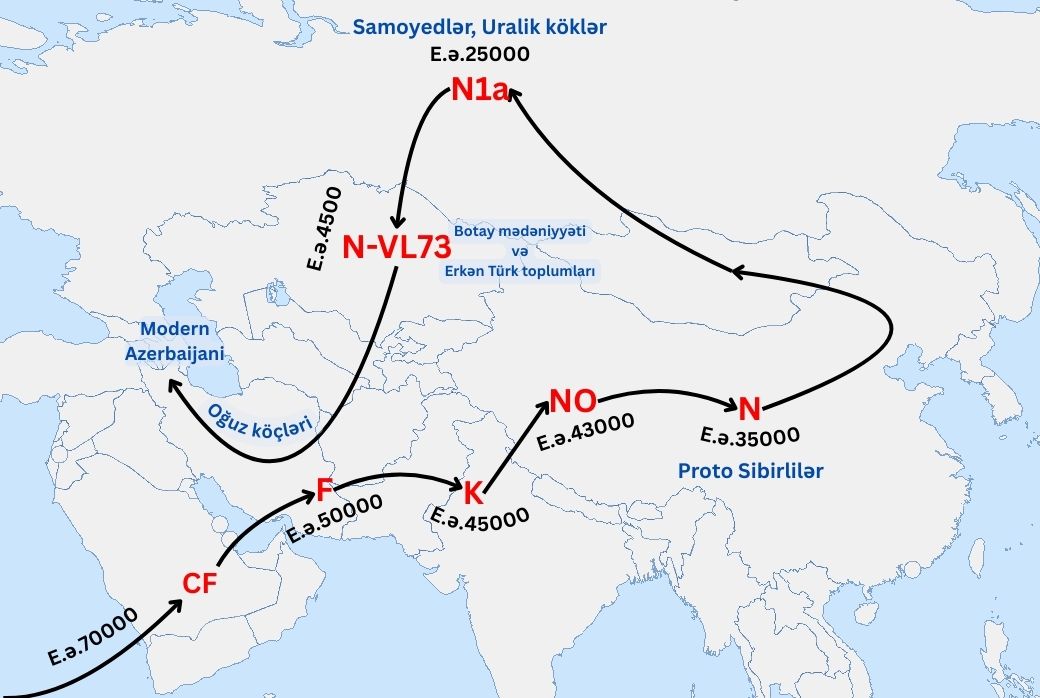
Chronology
~15,000 BCE – 10,000 BCE (Post-Last Glacial Period, North Asia / Siberia):
Haplogroup N1a spreads to northeastern Asia and Siberian forest-tundra zone where hunter–fisher and reindeer-herding communities predominate, and shamanistic belief systems develop.
Ethnic-cultural context: Early northern Siberian peoples, proto-Uralic and proto-Yenisei groups.
~5000 BCE – 3000 BCE (Middle Holocene, Western Siberia and Ural foothills):
Forest-steppe cultures (e.g., Seima-Turbino phenomenon) emerge. N carriers spread westward and contribute to the formation of Uralic languages.
Ethnic-cultural context: Proto-Uralic tribes; early metallurgy and initial traces of equestrian life.
~3500 BCE – 2500 BCE (Botai culture, Northern Kazakhstan):
Known for the first domestication of the Botai horse. At this stage, northern N components intermingle with emerging steppe cultures.
Ethnic-cultural context: First equestrian nomadic societies of Eurasia; initial layer in Turkic ethnogenesis.
~2000 BCE – 500 BCE (Andronovo – Sintashta – Scythian/Saka complex, Eurasian steppe):
N-VL73 carriers enter the Andronovo/Sintashta circle, then experience a period of extensive mixing with Saka-Scythian unions.
Ethnic-cultural context: Early steppe equestrian societies; formative stages of the Turkic proto-ethnos
500 CE – 1000 CE (Göktürk and early Turkic khaganates):
With the rise of the Göktürk Empire, N-VL73 carriers are already part of Turkic-speaking communities.
Ethnic-cultural context: The Proto-Turkic stage gradually gives way to the emergence of a distinct Turkic identity.
9th-11th centuries (Oghuz migrations):
Central Asian Oghuz tribes migrate westward to the Iranian plateau and Azerbaijan; synthesis occurs with local Iranian and Caucasian components.
Ethnic-cultural context: Formation of Oghuz-Turkmen identity.
From the Middle Ages to the present:
Turkic identity formed by the legacy of Oghuz migrations continues in Azerbaijan territory.
Final node:
Modern Azerbaijani — result of multi-layered genetic-cultural synthesis.